
· by Donna Dosado · 4 min read
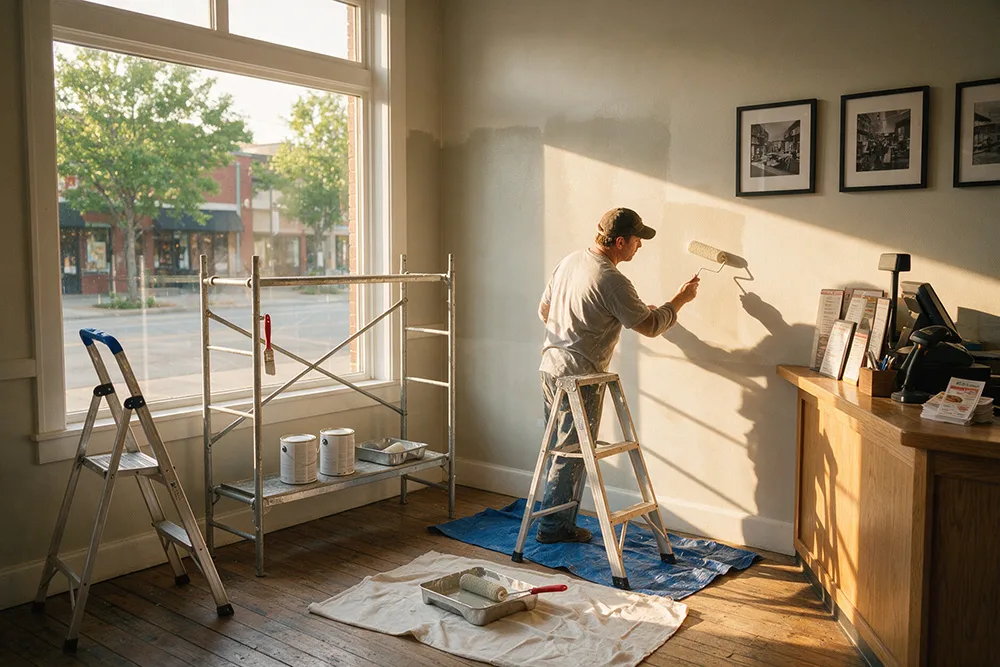
Closing a retail store or restaurant for a paint job is not always an option, and most business owners assume that means the project either waits or gets done poorly around open hours. Neither has to be true. After-hours commercial painting requires a different level of planning and management than a standard job, but when it is handled correctly the business keeps running and the finished work looks the same as if the building were empty. Contact Rusty's Painting at (407) 312-4803 to talk through the scheduling and logistics for your space.
How do professional painters actually approach an after-hours commercial job?
Efficiency becomes the priority alongside quality, because the window between closing time and when the business needs to be operational again is fixed and often short. Before work begins on the first shift, all materials for the entire project are ordered and on site. Access equipment is staged the day the project starts. Nothing about procurement or logistics should be solved at 11 p.m. when the supply houses are closed.
The project is then divided into sections. Each shift covers one defined section completely: prep the area, prime it, apply the finish coat, clean up fully before the business reopens. That full-section approach, rather than prepping the whole building then priming the whole building as a standard job would run, is less efficient by design. It is the trade-off that keeps the business open and the finished areas looking correct before customers come back in the next morning.
What logistics do business owners not realize go into an after-hours job?
After-hours labor carries a premium, which most business owners expect. What they rarely anticipate is the efficiency loss that comes from running a phased, sectioned project instead of a linear one. On a standard commercial painting job, the most efficient sequence is prep the entire building, prime the entire building, apply finish coats building-wide, then do all touch-ups at once. Each phase flows into the next without setup and teardown between them.
On an after-hours project, every shift requires re-staging equipment, re-organizing materials, and doing a full cleanup before leaving. That setup and breakdown time comes out of actual working hours. It also creates more waste in materials and clean-up supplies than a linear project generates. The management side of the job has to compensate for what the phased structure costs, and that is a real part of what separates a contractor who handles these jobs well from one who does not.
What about exterior painting at night? Is there a risk there?
There is a meaningful one. One of the most important environmental readings in any paint application is the relationship between the surface temperature and the dew point. If moisture forms on a surface before the paint coat has cured, the coat fails. At night, temperatures drop closer to the dew point than they are during the day, which makes exterior applications after dark genuinely risky without careful monitoring.
Rusty's Painting handled this specific situation on a large industrial mailing center that needed to stay operational during its full interior and exterior repaint. The solution was straightforward once the risk was explained clearly to the client: exterior work ran during the day, interior work ran at night. A double crew ran two shifts simultaneously to meet the owner's timeline for an upcoming event at the facility. The project was completed on time and on budget. The client referred Rusty's Painting to future business shortly after. Reach out to discuss your project and the same approach can be applied to your building's specific constraints.
How should a business owner prepare for an after-hours painting project?
The most useful thing a business owner can do before the project starts is have a clear conversation about scope and phasing. Which areas are off-limits to customers during work hours? Which sections can be painted in what order without disrupting the following day's operations? Are there materials being stored in sections of the building that need to be moved? These questions answered upfront, in writing, prevent the problems that come up at midnight when the crew is working and nobody is available to make decisions.
A Rusty's Painting Project Manager handles all of this coordination before mobilization and maintains daily communication throughout the project. The goal is for the business owner to be minimally involved once the project is underway, not called for decisions that should have been resolved before work started. Call Rusty's Painting at (407) 312-4803 or contact us online to start that conversation.