
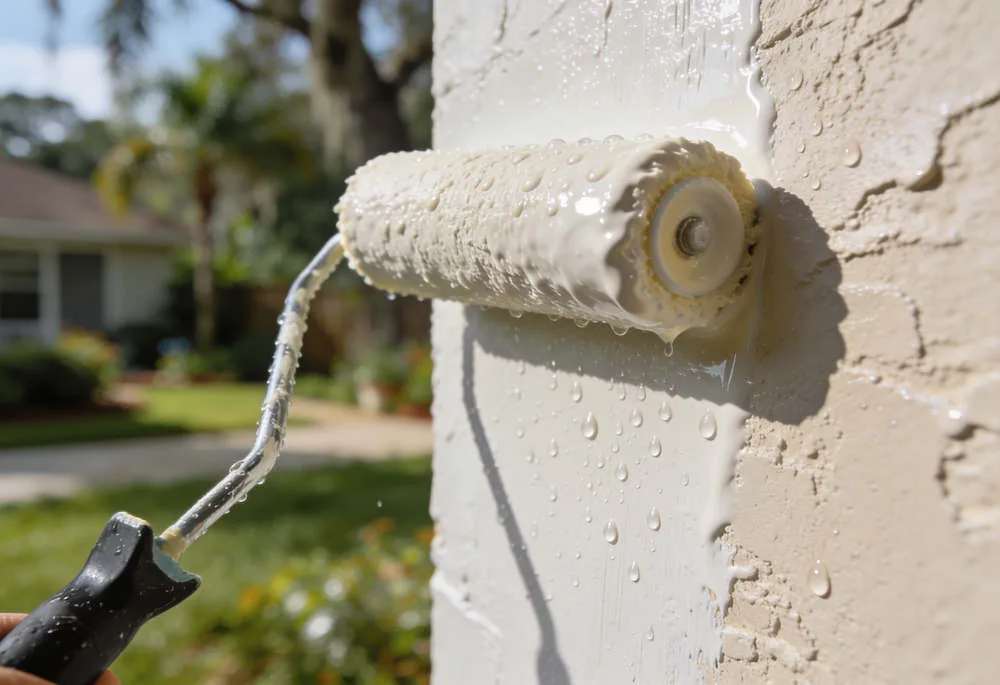
The dark streaking you see running down exterior walls is not dirt. It is mold and mildew, and in Orlando's humidity it is one of the most common exterior paint failures homeowners deal with. The right paint dramatically slows that growth. The wrong paint, or the right paint applied over an untreated surface, feeds the cycle instead of interrupting it. Rusty's Painting works specifically with the coatings and prep methods that hold up under Central Florida's conditions. Book a free estimate with Rusty's Painting or call (407) 312-4803 if you are already seeing streaking or discoloration on your walls.
Why Florida humidity turns ordinary paint into a mold problem
Homes in the Hunters Creek area of south Orlando and throughout Orange County face a specific combination of conditions that standard paint chemistry was not designed to handle at this intensity. Relative humidity in Central Florida rarely drops below 60 percent, and during summer months it is frequently above 80 percent through much of the day. Mold and mildew spores are present everywhere in outdoor air. They need two things to colonize a surface: moisture and a food source. Paint films that are cracked, chalky, or porous provide both. The moisture infiltrates the damaged film, and organic material in the paint binder or the substrate beneath it feeds the growth. Once established, mold colonies send root-like structures called hyphae into the surface. Washing removes what is visible above the film. It does not remove the colony embedded within it.
In the Windermere area west of Orlando, where mature tree canopy keeps north and west-facing walls shaded for much of the day, that combination intensifies. Shaded surfaces stay damp longer after rain events. They receive less UV exposure, which would otherwise slow biological growth. The result is that mold and mildew establish faster and deeper on shaded elevations, sometimes within two years of a paint application that used an inadequate product or skipped proper surface prep before application.
The Winter Park area east of Orlando shows the same pattern on stucco homes. Stucco is more porous than wood or fiber cement siding, which means it holds moisture within the surface texture rather than shedding it. A paint film on stucco that develops even hairline cracks allows capillary action to draw water into the substrate, creating a persistently damp zone behind the paint where mold thrives regardless of what the surface looks like from the street.
What the chemistry of mold-resistant paint actually does
The key properties that separate a paint capable of resisting Florida mold and mildew from one that cannot are flexibility, film integrity, water shedding, and mildewcide concentration.
100% acrylic formulations are the baseline for Florida exterior work. Acrylic binders remain flexible as the paint film expands and contracts with temperature, rather than becoming brittle and cracking at thermal stress points. That flexibility is what keeps the film intact and water out. Cheaper paints use vinyl-acrylic or alkyd binders that become progressively more rigid over time, developing microscopic cracks that open pathways for moisture even before the paint shows visible failure.
Elastomeric coatings are a higher-performance category within the acrylic family. They are applied at a significantly greater film thickness than standard paints, which gives them the ability to bridge existing hairline cracks rather than just coating over them. An elastomeric coat on a stucco surface that has minor checking can seal those cracks within the film itself, eliminating the entry points that would otherwise allow moisture infiltration. The rubber-like flexibility of the cured film means it moves with the surface through heat cycles without losing that seal.
Mildewcide additives are a separate component from the binder system. They are biocidal compounds incorporated into the paint formulation that inhibit fungal growth on the surface. The concentration and type of mildewcide determines how effectively the paint resists biological colonization under sustained humidity exposure. Products formulated for high-humidity Southern climates carry higher mildewcide loads than general-purpose exterior paints sold in national chains, and that difference is meaningful in Central Florida's conditions.
Why prep matters as much as the paint itself
Applying a premium mold-resistant coating over an existing mold colony accomplishes nothing beyond covering the problem temporarily. Within a season, the colony beneath the film continues to grow and eventually pushes through or around the new paint. The prep sequence that actually interrupts the cycle requires treating the existing biological growth before any new coating is applied.
The correct sequence for a mold-affected Florida exterior:
- Pressure washing at appropriate pressure to remove surface contamination, loose paint, and chalk
- Application of a mildewcide solution to treated areas, followed by adequate dwell time and rinsing
- Allowing the surface to dry completely, which in Florida humidity may require more time than the calendar suggests
- Spot priming over bare substrate areas, stucco repairs, and any previously affected zones with a bonding or mold-inhibiting primer
- Caulking all penetrations, gaps around windows, and trim joints before topcoat application
Each step builds on the previous one. A premium topcoat on a properly prepped surface performs close to its rated capability. The same coating on a surface that skipped mildewcide treatment will show re-infestation well ahead of schedule.
What this looks like in practice
When Rusty's Painting takes on an exterior painting project on a home showing mold or mildew staining, the prep work is not abbreviated to hit a lower price point. The surface is treated, dried, primed correctly for the substrate, and coated with product formulated for Florida's specific climate demands. That sequence is what produces a finish that holds up to the next inspection rather than showing streaking again within two years.
Homeowners who are also dealing with interior moisture issues related to the same climate conditions can address interior painting in the same project cycle, particularly in bathrooms or laundry areas where humidity-resistant products make a comparable difference.
If your Orlando home's exterior already has visible mold streaking, the free estimate is the place to start. Call Rusty's Painting at (407) 312-4803 or schedule your free mold-resistant repaint estimate with Rusty's Painting and find out exactly what the surface needs before the next rainy season.