
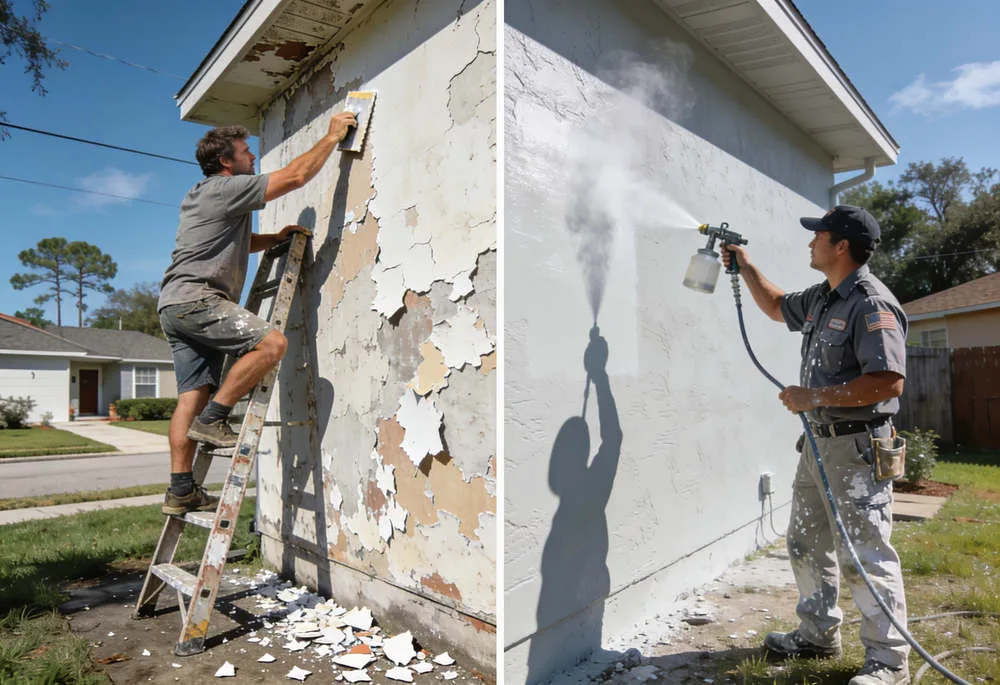
Painting your home's exterior yourself is possible, and for some homeowners it makes sense. But Florida is one of the hardest environments in the country to get a durable exterior paint job, and most of the variables that determine how long the finish lasts are the ones DIY projects are most likely to shortcut. The honest comparison is not just labor cost versus contractor quote. It is how long each approach actually holds up in this climate. Rusty's Painting serves homeowners across Orlando, Apopka, and Altamonte Springs who are weighing exactly this decision. Get a free estimate from Rusty's Painting or call (407) 312-4803 before you commit to either path.
What DIY exterior painting in Florida usually looks like in practice
Homeowners in the College Park neighborhood of Orlando who take on a DIY exterior paint project typically underestimate two things: the prep time and the application window. Prep on a Florida home is not a quick power wash and a coat of primer. Stucco surfaces, which cover the majority of Central Florida homes, require a specific sequence: pressure washing to remove chalk and mold, allowing adequate dry time, spot-filling any cracks or voids, applying a bonding primer on bare or repaired areas, and caulking all penetrations before a single brush or roller touches the topcoat. Skipping or rushing any of those steps does not just reduce the quality of the finish. It creates the conditions for early peeling, often within the first year.
The heat itself adds a layer of complexity that homeowners in the Conway area and similar Orlando suburbs discover quickly. Most exterior paints have application temperature windows, typically between 50 and 90 degrees Fahrenheit, and they need to avoid direct sunlight on the surface during application. In Orlando from April through October, that narrows the workable hours to early morning, before the surface heats up under direct sun. By 10 or 11 a.m. on a summer day, many exterior walls are too hot for proper adhesion and film formation. A weekend project that starts at 8 a.m. may only have three or four usable hours before the temperature forces a stop. Across a full home, that compresses into multiple weekends of interrupted work, and weather can wipe out planned days entirely.
Ladder safety is the third variable that does not show up in the line-item comparison. Most Florida homes have two-story sections or roof lines that require ladder work at meaningful height, on surfaces that may be slick from morning humidity. The Sanford and Lake Mary areas north of Orlando have seen plenty of weekend painting projects that ended with a trip to urgent care rather than a finished fascia. That risk is worth naming plainly, not as a scare tactic, but because it is a real cost that does not appear in the paint budget.
What a professional finish controls that DIY usually does not
The quality gap between a professional exterior painting project and a DIY one in Florida almost never comes down to technique on the wall. It comes down to prep depth, product selection, and application method. A professional crew pressure washes with appropriate pressure for the substrate, treats any mold or mildew before priming rather than painting over it, and applies a full bonding primer system on stucco that creates the adhesion layer the topcoat needs to survive thermal cycling. None of that is complicated, but it is time-consuming, and it is the part most homeowners shorten when a project stretches across multiple weekends.
Product selection is the other variable. Rusty's uses 100% acrylic and elastomeric coatings formulated for Florida's UV exposure and humidity levels. Elastomeric products have a higher build, greater flexibility across temperature swings, and better mildewcide resistance than most consumer-grade exterior paints available at a home improvement store. The formulation difference matters because Florida's climate stress-tests paint chemistry in ways that a milder climate does not. A product rated for ten years under moderate conditions may perform well within its ratings. The same product under Central Florida UV load and humidity may reach the end of its usable life at five or six years.
Spray application and why it matters on stucco
Stucco has a textured surface that rollers and brushes do not coat uniformly at the depth required for a durable finish. Spray application fills the texture profile more completely, produces a more even mil thickness across the surface, and is the method used on new construction for a reason: it works. A brush-and-roll DIY project on stucco can look acceptable initially and develop thin spots that fail earlier, particularly on south and west-facing walls that take the most direct UV exposure. Professional spray application is one of the less-discussed but meaningful differences in how long a finish holds up under Florida conditions.
Where interior work fits into the picture
Homeowners who are already coordinating an exterior project sometimes find it practical to schedule interior painting in the same season. Rusty's handles both, and managing the work together reduces the disruption of two separate project timelines. Interior rooms that have been showing wear or that will be visible through freshly painted trim from outside are natural candidates to address at the same time.
If you are weighing whether to take on your Orlando home's exterior yourself or hire a professional, the free estimate gives you a concrete number to compare against your own time and materials calculation. Call Rusty's Painting at (407) 312-4803 or schedule your free estimate with Rusty's Painting and make that decision with real numbers in hand.