
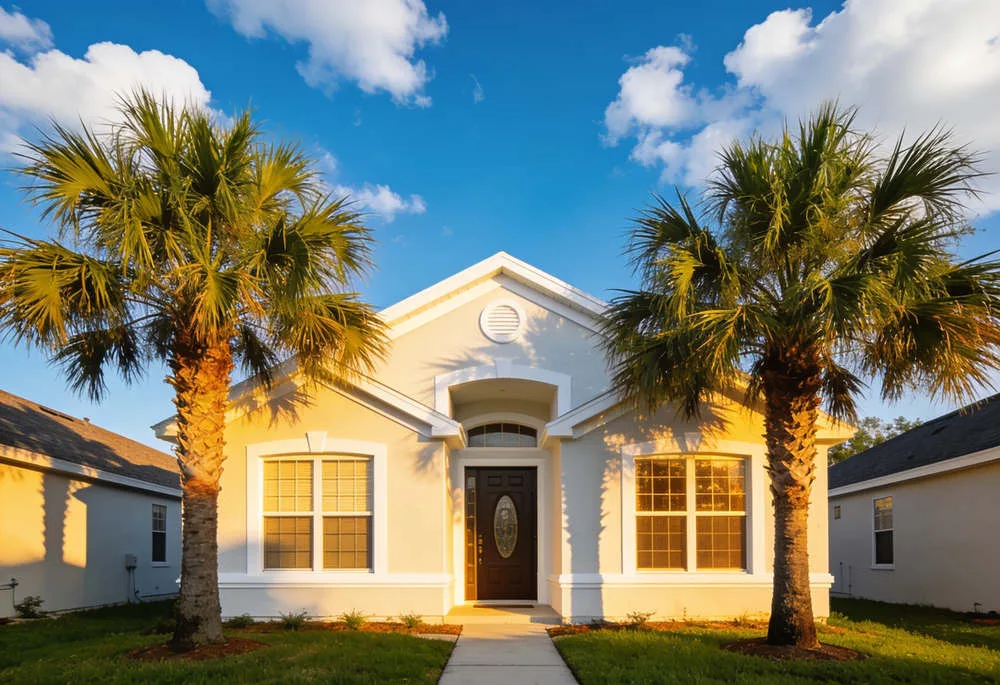
Orlando homeowners should plan to repaint their home's exterior roughly every five to seven years. That interval is shorter than national recommendations because Florida's UV intensity, heat, and humidity break down paint chemistry faster than the conditions most product specifications are written for. A paint job that would last ten years in a northern climate may show visible failure at six in Central Florida. Rusty's Painting works with homeowners across the Orlando area who are navigating exactly this cycle. Request a free estimate from Rusty's Painting or call (407) 312-4803 to have someone take a look at what your exterior is telling you.
Why Florida degrades paint faster than almost anywhere else
Homes in the Apopka area and throughout Orange County sit under some of the highest UV radiation levels in the continental United States for most of the year. UV exposure does not just fade color. It breaks down the binder that holds paint pigment to the surface, a process called chalking. Run your hand across a home that is overdue for a repaint and the powdery residue that comes off on your palm is the binder failing. Once chalking starts, the paint film is no longer sealing the substrate beneath it, and water infiltration becomes the next problem in line.
Heat compounds the issue in a different way. Paint expands and contracts with temperature. In the Thornton Park neighborhood of Orlando, where afternoon highs push into the nineties for months at a stretch, lower-quality paints that lack sufficient flexibility develop hairline cracks along this expansion and contraction cycle. Those cracks are entry points for moisture. Stucco homes are particularly vulnerable because the underlying material is porous, and once water gets behind a failing paint film on a stucco surface, you are dealing with both a paint failure and a substrate repair.
Then there is humidity. The Altamonte Springs area north of Orlando, like most of Central Florida, sees high relative humidity through most of the year. Humidity creates the conditions mold and mildew need to establish on exterior surfaces. A paint film that is not formulated with mildewcide resistance will begin showing black or green streaking within a few years, particularly on north-facing walls and under soffits where sunlight does not dry the surface between rain events. That staining is not cosmetic. It is biological growth embedded in or under the paint film, and washing it off without addressing the underlying surface before repainting means painting over a contaminated substrate.
The warning signs that tell you it is time
The five-to-seven-year range is an average, not a guarantee in either direction. The actual condition of your specific home's paint is more informative than the calendar. These are the signs that the exterior is overdue:
- Chalking: a powdery residue on the surface when you run your hand across it, particularly on south-facing walls that receive the most direct sun
- Fading or color shift: paint that looks significantly lighter or washed out compared to shaded areas or original color samples
- Peeling or flaking: the paint film separating from the substrate, usually starting at edges, around windows, or along trim
- Cracking or checking: fine hairline cracks running across the paint surface, often following a grid pattern on stucco
- Mold or mildew staining: dark streaking on north walls, under eaves, or in shaded areas, particularly after a wet season
- Caulk failure: cracked or missing caulk around windows and door frames, which allows water behind the paint film regardless of the paint's condition
Any one of these on its own warrants a closer look. Several of them together mean the repaint is overdue, and continuing to delay adds substrate damage to a paint problem.
Why the paint and the prep both determine how long a job lasts
The quality of the coating matters enormously in Florida, but the preparation beneath it matters at least as much. A premium paint applied over a dirty, chalky, or mold-contaminated surface will fail early because adhesion depends on a clean, properly primed substrate. The prep sequence for a Florida exterior repaint should include pressure washing to remove chalk, dirt, and biological growth, spot treatment or priming over bare areas and repaired stucco, caulking all penetrations and gaps before any paint is applied, and a primer coat where the substrate condition warrants it.
The coating itself should be a 100% acrylic or elastomeric product formulated for Florida's climate conditions. Elastomeric coatings have a higher build and greater flexibility than standard acrylics, which makes them particularly effective on stucco surfaces where thermal movement is significant. Both types resist mildew better than lower-grade alternatives when the mildewcide concentration is appropriate. Exterior painting done with the right materials and the right prep does not just look better. It holds up longer, which is the actual measure of value in a Florida climate.
Interior work and the full-service option
Many homeowners who are scheduling exterior work find it efficient to address interior projects in the same season, particularly rooms that share walls or trim styles with the exterior repaint. Rusty's Painting handles interior painting with the same attention to prep and product quality, and coordinating the work reduces the disruption of managing two separate projects across different weeks.
If your Orlando home has not been repainted in the past five to seven years, or if you are seeing any of the warning signs above, the free estimate is the right next step. Call Rusty's Painting at (407) 312-4803 or schedule your free exterior estimate with Rusty's Painting and get an honest assessment of what your home needs.