
· by Donna Dosado · 4 min read
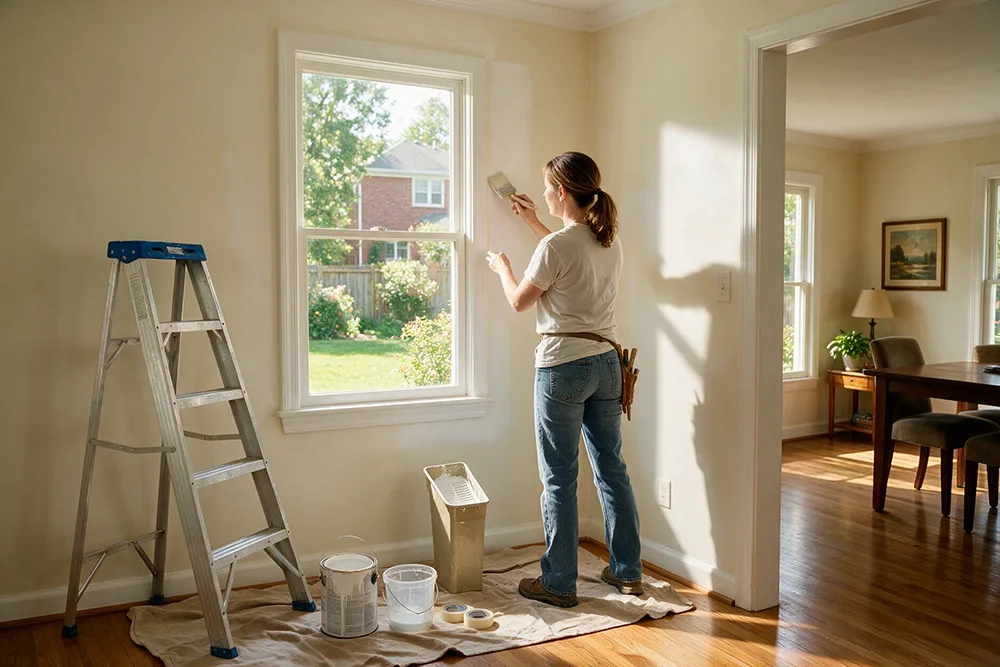
Touching up a painted wall sounds like the obvious solution to a scuff or a small damaged area. Dab some paint on, feather the edges, done. In practice, that approach almost never produces a result that looks right, and professional painters see the aftermath of it constantly. The wall ends up looking worse than the original scuff did. Contact Rusty's Painting at (407) 312-4803 you have walls that need proper attention.
Why does paint touch-up produce a visible spot instead of blending in?
Paint on a wall ages from the moment it is applied. It cures, it is exposed to light, it accumulates microscopic surface texture from the environment, and its sheen changes over time. A fresh coat of the exact same paint, applied to the same wall months or years later, does not match the surrounding surface because the surrounding surface is not what it was when it was first painted. The fresh paint and the aged paint reflect light differently. That difference is visible, sometimes strikingly so, which is what produces the "poke-a-dot" finish that touch-up painting consistently creates.
Feathering the edges, blending the wet paint into the surrounding surface by softening the boundary, is the technique most people attempt to get around this. It works in some applications, like body filler on an automobile, where the surrounding surface is also being prepared to receive the blend. On a flat interior wall that is not being resurfaced, feathering a touch-up does not eliminate the sheen and color difference between the fresh paint and the aged wall. It just softens the edge of a spot that still reads as a spot.
What is the correct way to handle a scuffed or damaged wall section?
The correct approach is to paint the full wall section from natural stopping point to natural stopping point. A corner, a door casing, a window frame, a ceiling line: these are the boundaries that define a discrete section of wall. When the entire section between two natural boundaries is repainted, the new coat is seen as a complete surface rather than a patch within an older one. The eye reads corners and edges as visual breaks. It does not notice that the paint on one side of a corner is newer than the paint on the other side. Rusty's Painting follows this approach on every repaint and touch-up project because anything less produces a finish that visibly fails the quality standard.
The natural stopping point may be close to the damaged area or it may be several feet away. That distance does not change the approach. Painting a two-foot section of wall to address a scuff at one end of it is not a shortcut. It is a smaller version of the same problem. The only way to avoid the touch-up spot is to paint the full section.
Does this mean a single scuff always requires painting the whole room?
Not necessarily. It means painting the full wall section defined by its natural boundaries. In a room where the walls are divided into clear sections by corners, architectural features, or trim, a single wall or section of a wall is often the only area that needs to be repainted. In an open-plan space without natural dividing features, the practical section may be larger. The goal is to repaint within boundaries that the eye accepts as complete, not to repaint the minimum area that covers the damage.
This is also why matching paint matters less than people think. Even a perfect color match on a touch-up produces a visible spot because the issue is sheen and surface aging, not color. The solution is not better color matching. It is repainting the complete section. Contact Rusty's Painting at (407) 312-4803 for interior repaint work done the way it needs to be done.